
Welcome to our new website and brand. We’re grateful for our continued partnership with the San Francisco Chronicle and the Evelyn and Walter Haas, Jr. Fund.

December 3, 2025
Share this Article
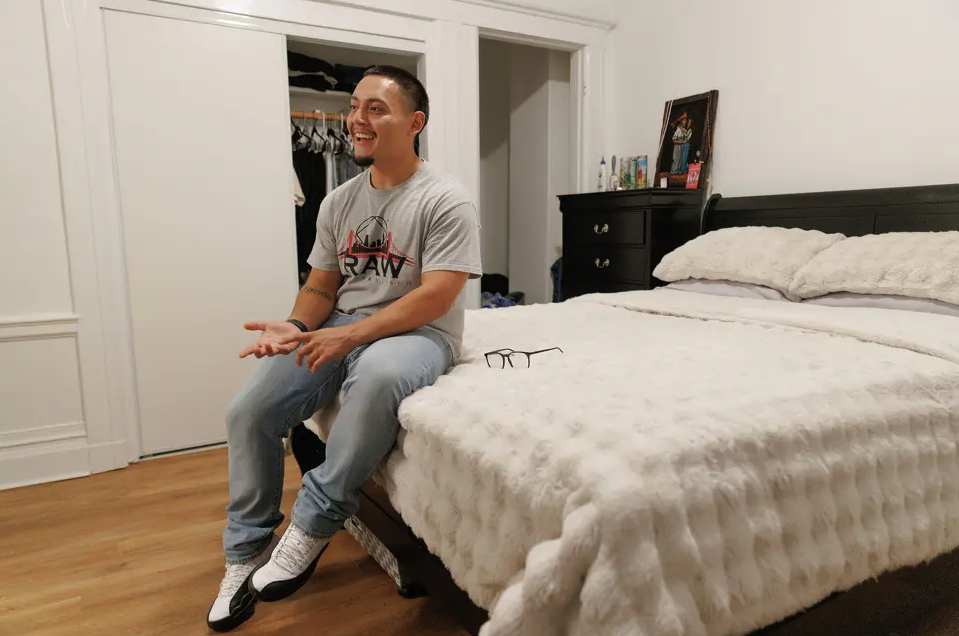
Young man sits on bed smiling.

Season of Sharing Fund helped him break the ‘cycle of despair’ and start over in a home of his own

When David Chavez graduated from the one-year St. Anthony’s residential recovery program in San Francisco, his gift from St. Anthony’s was a lead on a studio apartment in the Tenderloin. It would be the first place of his own: He was 27 and had spent his adult life living in the crowded confines of jails and prisons, or on the street.

Chavez had a part-time minimum-wage job at Target, but he didn’t have money for the deposit or first month’s rent. He also didn’t have any furniture or the means to buy it, but that concern was a distant second. He’d sleep on the floor if it came to it.

Luckily it didn’t, because his counselor at St. Anthony’s referred his case to the Season of Sharing Fund. The fund works year-round across the nine-county Bay Area region to prevent homelessness and hunger among residents in need. All donations go directly to help people in need.

Arrangements were made to transfer money for his first and last month’s rent to his new landlord — and, much to his surprise, a new queen-sized mattress, wooden bed frame and matching dresser were included in the deal. He picked them out, but he didn’t even have to move them.

“They made it so easy,” said Chavez, as he sat at the table in his bedroom/dining room/media lounge. He was wearing a T-shirt with the slogan “Recovery at work” on it. 

That’s a slogan he is living. Since Chavez moved in this April, he has advanced from that part-time job at Target to a full-time position with benefits at the Hygiene Hub at St. Anthony’s.

“I’m taking my time with it, because recovery is an ongoing process.”

The paycheck has allowed him to finish furnishing the place with a 44-inch TV and stand — though he does not have time to watch it, because in addition to a 40-hour-per-week job, he is in school at City College of San Francisco, pursuing his Associate of Arts degree in social work. He’s also two steps into a 12-step addiction recovery program, though completing that could take longer than finishing his A.A.

“I’m taking my time with it, because recovery is an ongoing process,” he said, noting books with the titles “Living Clean” and “Guiding Principles” on display on his coffee table, along with the New Testament of the Bible.

Man at desk with laptop.
David does course work at his apartment in San Francisco on Nov. 13. He is in school at City College of San Francisco, pursuing an associate of arts degree in social work, and dreams of going to UC Berkeley. Santiago Mejia/S.F. Chronicle

Soft-spoken and polite, with an immaculate apartment and a bed made so tight it could pass muster at military school, it is hard to picture Chavez in his prior residences, both at San Quentin and at Pelican Bay State Prison, the maximum security lockup where the toughest cases are sent, as part of an 18-month sentence for residential burglary.

He doesn’t want to talk about how he ended up there, but he will recall where it all went wrong: South Berkeley, where he grew up with his mother in a place so close to the Ashby BART Station that he could hear the trains going by on the elevated tracks into the tunnel.

His mother was a bank loan officer, and he had a goal of playing offensive line for the California Golden Bears football team at UC Berkeley. He made it through Pop Warner with the Berkeley Junior Bears but veered off that path and into trouble.

“I was already in the streets,” he said. His older brother and role model was in prison when David was first sent to juvenile hall, at age 13, to serve a sentence for armed robbery. That was the start of many convictions and jail sentences, both as a juvenile and as an adult, though he was never again convicted of a crime involving a weapon, he said.

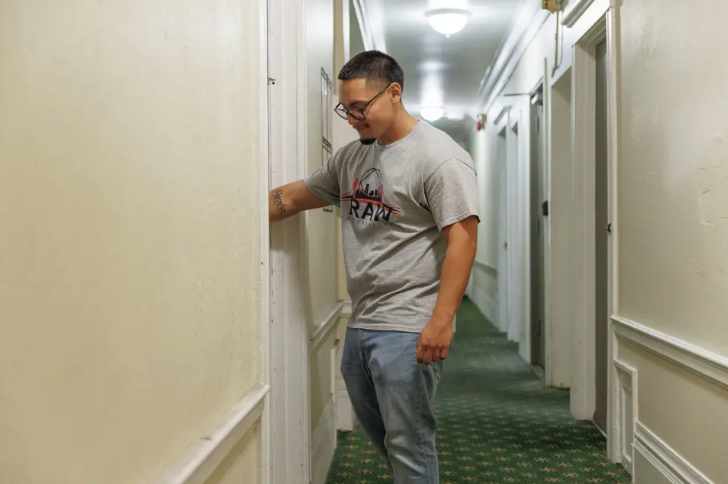
Young man standing in apartment building hallway.
“You can see where addiction leads people to,” David says. “It’s a vicious cycle of despair and no hope.” Now, says his caseworker at St. Anthony’s, “he’s the embodiment of hope for the Tenderloin community.” Santiago Mejia/S.F. Chronicle
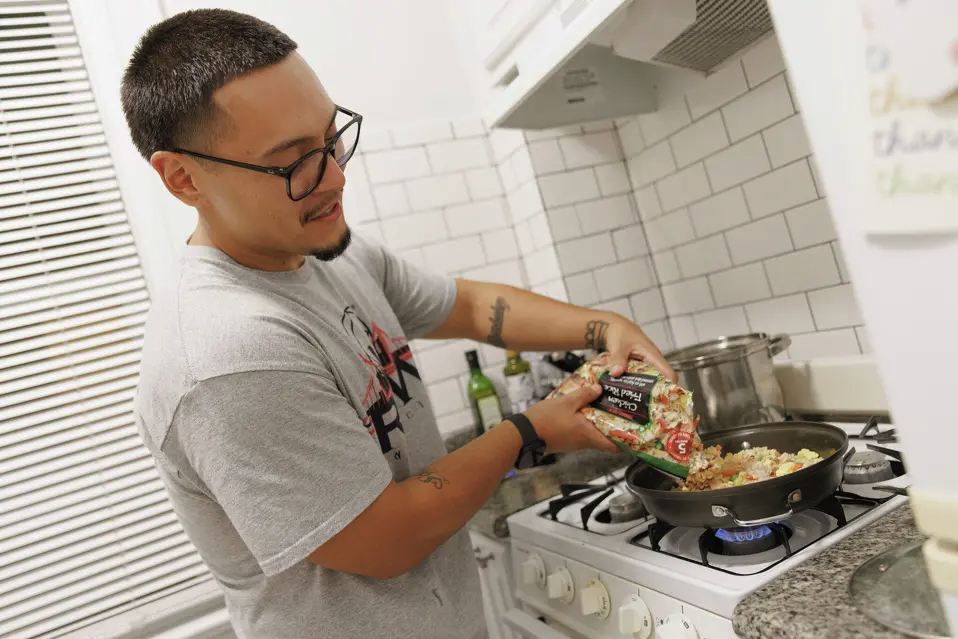
Man cooks food in apartment kitchen.
After years of drug addiction, homelessness and stints in prison, David is turning his life around in San Francisco — and has landed his first-ever apartment, thanks to help from the Season of Sharing Fund. Santiago Mejia/S.F. Chronicle

“You can see where addiction leads people to,” he said. “It’s a vicious cycle of despair and no hope.”

“They were all nonviolent offenses. Just things I did to support my drug habit,” he said, declining to identify the drug. He had convictions in Alameda County, San Mateo County, and the city and county of San Francisco, and served time in county jails and state prisons.

“You can see where addiction leads people to,” he said. “It’s a vicious cycle of despair and no hope.”

The cycle ended on March 25, 2024, the day he was released on probation from Santa Rita Jail in Dublin. His cousin picked him up, and after a weekend at home, his mother, Sandra Chavez, took time off from her job to drive him across the bay to the Father Alfred Residential Treatment Center in San Francisco’s South of Market neighborhood. It is run by the St. Anthony Foundation, a nonprofit in its 75th year offering its namesake dining room, along with a range of health services.

Checking into the center marked the first time he’d stayed overnight in San Francisco since he’d spent a week at county jail, in 2023. He’d tried programs before, but none of them had stuck. “This time I was just tired, man,” he said.

The free program requires a one-year commitment, though there is no enforcement mechanism. He could have walked out anytime, but he stayed with it.

“He’s really resilient despite all the challenges in his life,” said his caseworker at St. Anthony’s, Lauren Urbina-Blanco. “He’s the embodiment of hope for the Tenderloin community.”  

Chavez does not know how long he will be in his Tenderloin apartment or even in the city. His goal is to make it to UC Berkeley, though he knows he is too small and too old for the offensive line on the football field. He said he has a 4.0 GPA after two semesters at City College.

“He is just the sweetest,” said Sally Haims, chief communications officer at St. Anthony’s. “He’s a ray of light on our campus.”

His job in the Hygiene Hub involves supervising people who come in for a shower or to do their laundry. He also provides an example of recovery, though that’s not in his job description.

“That’s just something I do,” he said, “to be of service to the next suffering addict.”

Reach Sam Whiting: swhiting@sfchronicle.com

WAYS TO HELP

Neighbors Help Neighbors

At Season of Sharing Fund, we believe that an unexpected financial crisis should never mean losing your home. Preventing homelessness isn’t just kind—it’s also the most effective way to keep our communities thriving. 100% of your donation keeps Bay Area residents housed, cared for and nourished.

JOIN OUR NEWSLETTER

Inspiration and Impact, Right in Your Inbox

We'll use the following information to send you monthly newsletters and stories of inspiration about your Bay Area neighbors.
This field is for validation purposes and should be left unchanged.
Hello, my name is:(Required)
Privacy Policy(Required)

Latest Stories of Hope